Resources
Clarity That
Converts
Practical insights on learning strategy, educational video, and scalable content systems for eLearning and EdTech teams.
Explore insights, strategies, and stories made for YouTube creators who want to grow.
Category
All
Clarity
Engagement
Conversion
Scale

How to Reduce SME Review Time Without Sacrificing Accuracy
The goal is not to involve SMEs less where accuracy matters. It is to use their limited time on the decisions that genuinely require their expertise.

How to Scale a Video Library Without Losing Consistency
Consistency at scale does not come from making every video identical. It comes from defining which decisions should remain stable and which should adapt to the learning objective.

The Hidden Cost of Rebriefing a New Video Freelancer for Every Project
The invoice for a video does not show the internal hours spent explaining the audience, content, visual standards, approval process, and earlier decisions all over again.

Why Clear Course Previews Increase Learner Confidence
A strong course preview does not simply promote the curriculum. It lets prospective learners experience enough of the teaching to imagine themselves succeeding.

How to Turn Product Features Into Clear EdTech Onboarding
Users do not adopt a platform because they have seen every feature. They adopt it when they can use the right features to accomplish an important job.

How Educational Videos Can Support Course Conversions
Video does not improve conversions simply by appearing on a landing page. It works when it helps prospective learners understand the outcome, experience, credibility, and fit of the course.

What Makes an Educational Video Truly Engaging?
Engagement is not a layer of energy added during editing. It begins with a relevant objective and continues through every choice about explanation, visuals, pacing, and learner participation.
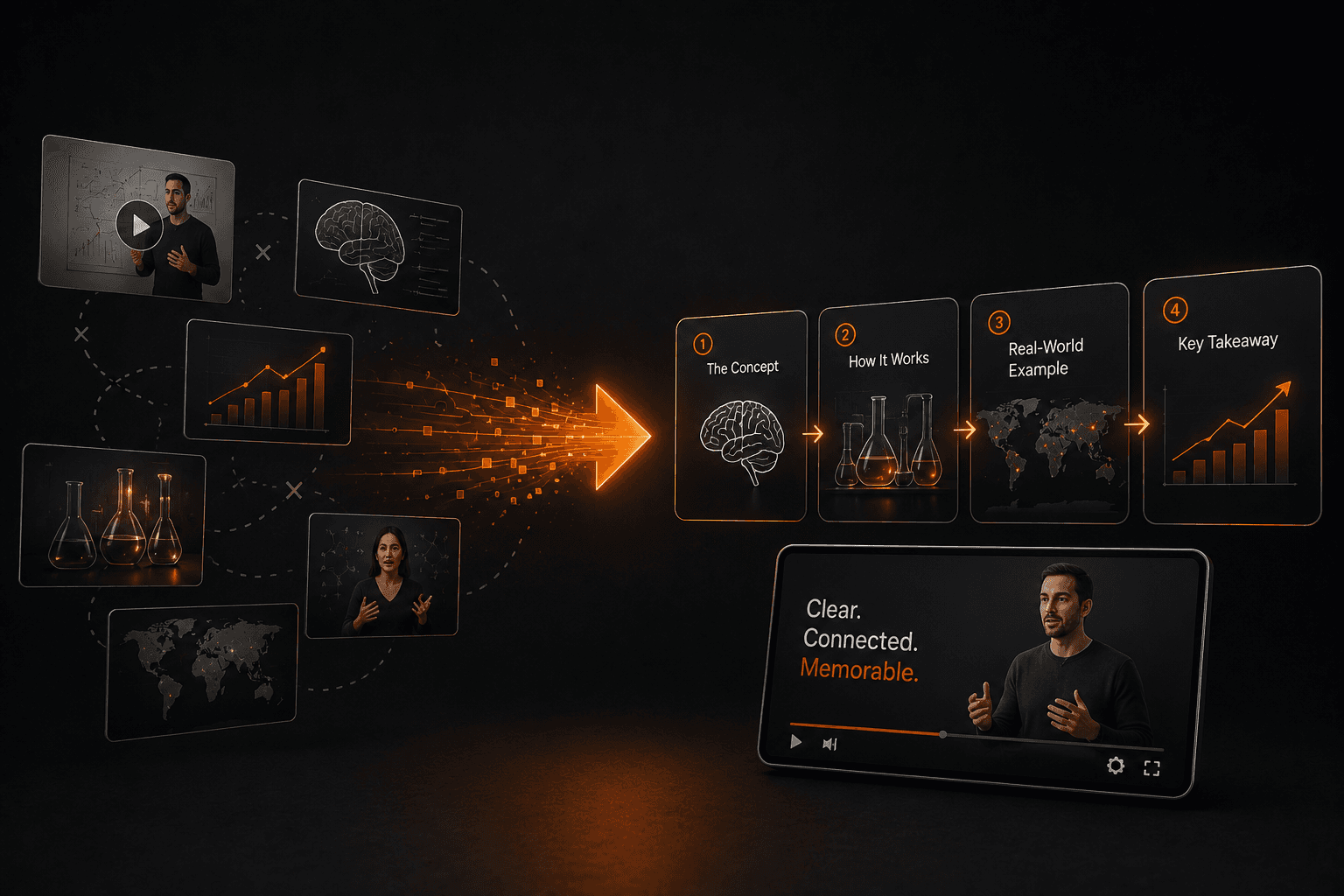
How Visual Storytelling Helps Learners Understand and Remember
Storytelling in education is not about adding drama to every lesson. It is about giving information a meaningful sequence: a situation, a challenge, a decision, and a result.

How to Turn Expert Knowledge Into Content Learners Actually Understand
Experts organize information around everything they know. Learners need it organized around what they need to understand and do next. Here is how to bridge that gap.

Accurate but Confusing: Why Educational Content Still Fails Learners
A lesson can contain no factual errors and still fail. Learners also need structure, context, emphasis, and a clear path through the information.

How Visuals Make Complex Concepts Easier to Understand
The right visual does more than make a lesson attractive. It exposes relationships, sequence, change, and scale that would otherwise remain hidden inside the explanation.
Premium Plan
Need Help Applying This
to Your Content?
Need Help Applying This
to Your Content?
Apply these ideas to your own content, or bring us your challenge and build the right production plan together.
Apply these ideas to your own content, or bring us your challenge and build the right production plan together.
Need Help Applying This to Your Content?
Category
All
Clarity
Engagement
Conversion
Scale
Category
All
Clarity
Engagement
Conversion
Scale
How to Reduce SME Review Time Without Sacrificing Accuracy
The goal is not to involve SMEs less where accuracy matters. It is to use their limited time on the decisions that genuinely require their expertise.
How to Scale a Video Library Without Losing Consistency
Consistency at scale does not come from making every video identical. It comes from defining which decisions should remain stable and which should adapt to the learning objective.
The Hidden Cost of Rebriefing a New Video Freelancer for Every Project
The invoice for a video does not show the internal hours spent explaining the audience, content, visual standards, approval process, and earlier decisions all over again.
Why Clear Course Previews Increase Learner Confidence
A strong course preview does not simply promote the curriculum. It lets prospective learners experience enough of the teaching to imagine themselves succeeding.
How to Turn Product Features Into Clear EdTech Onboarding
Users do not adopt a platform because they have seen every feature. They adopt it when they can use the right features to accomplish an important job.
How Educational Videos Can Support Course Conversions
Video does not improve conversions simply by appearing on a landing page. It works when it helps prospective learners understand the outcome, experience, credibility, and fit of the course.
What Makes an Educational Video Truly Engaging?
Engagement is not a layer of energy added during editing. It begins with a relevant objective and continues through every choice about explanation, visuals, pacing, and learner participation.
How Visual Storytelling Helps Learners Understand and Remember
Storytelling in education is not about adding drama to every lesson. It is about giving information a meaningful sequence: a situation, a challenge, a decision, and a result.
How to Turn Expert Knowledge Into Content Learners Actually Understand
Experts organize information around everything they know. Learners need it organized around what they need to understand and do next. Here is how to bridge that gap.
Accurate but Confusing: Why Educational Content Still Fails Learners
A lesson can contain no factual errors and still fail. Learners also need structure, context, emphasis, and a clear path through the information.
How Visuals Make Complex Concepts Easier to Understand
The right visual does more than make a lesson attractive. It exposes relationships, sequence, change, and scale that would otherwise remain hidden inside the explanation.
How to Reduce SME Review Time Without Sacrificing Accuracy
The goal is not to involve SMEs less where accuracy matters. It is to use their limited time on the decisions that genuinely require their expertise.
How to Scale a Video Library Without Losing Consistency
Consistency at scale does not come from making every video identical. It comes from defining which decisions should remain stable and which should adapt to the learning objective.
The Hidden Cost of Rebriefing a New Video Freelancer for Every Project
The invoice for a video does not show the internal hours spent explaining the audience, content, visual standards, approval process, and earlier decisions all over again.
Why Clear Course Previews Increase Learner Confidence
A strong course preview does not simply promote the curriculum. It lets prospective learners experience enough of the teaching to imagine themselves succeeding.
How to Turn Product Features Into Clear EdTech Onboarding
Users do not adopt a platform because they have seen every feature. They adopt it when they can use the right features to accomplish an important job.
How Educational Videos Can Support Course Conversions
Video does not improve conversions simply by appearing on a landing page. It works when it helps prospective learners understand the outcome, experience, credibility, and fit of the course.
What Makes an Educational Video Truly Engaging?
Engagement is not a layer of energy added during editing. It begins with a relevant objective and continues through every choice about explanation, visuals, pacing, and learner participation.
How Visual Storytelling Helps Learners Understand and Remember
Storytelling in education is not about adding drama to every lesson. It is about giving information a meaningful sequence: a situation, a challenge, a decision, and a result.
How to Turn Expert Knowledge Into Content Learners Actually Understand
Experts organize information around everything they know. Learners need it organized around what they need to understand and do next. Here is how to bridge that gap.
Accurate but Confusing: Why Educational Content Still Fails Learners
A lesson can contain no factual errors and still fail. Learners also need structure, context, emphasis, and a clear path through the information.
How Visuals Make Complex Concepts Easier to Understand
The right visual does more than make a lesson attractive. It exposes relationships, sequence, change, and scale that would otherwise remain hidden inside the explanation.