Engagement
How Visual Storytelling Helps Learners Understand and Remember
How Visual Storytelling Helps Learners Understand and Remember
How Visual Storytelling Helps Learners Understand and Remember
Storytelling in education is not about adding drama to every lesson. It is about giving information a meaningful sequence: a situation, a challenge, a decision, and a result.
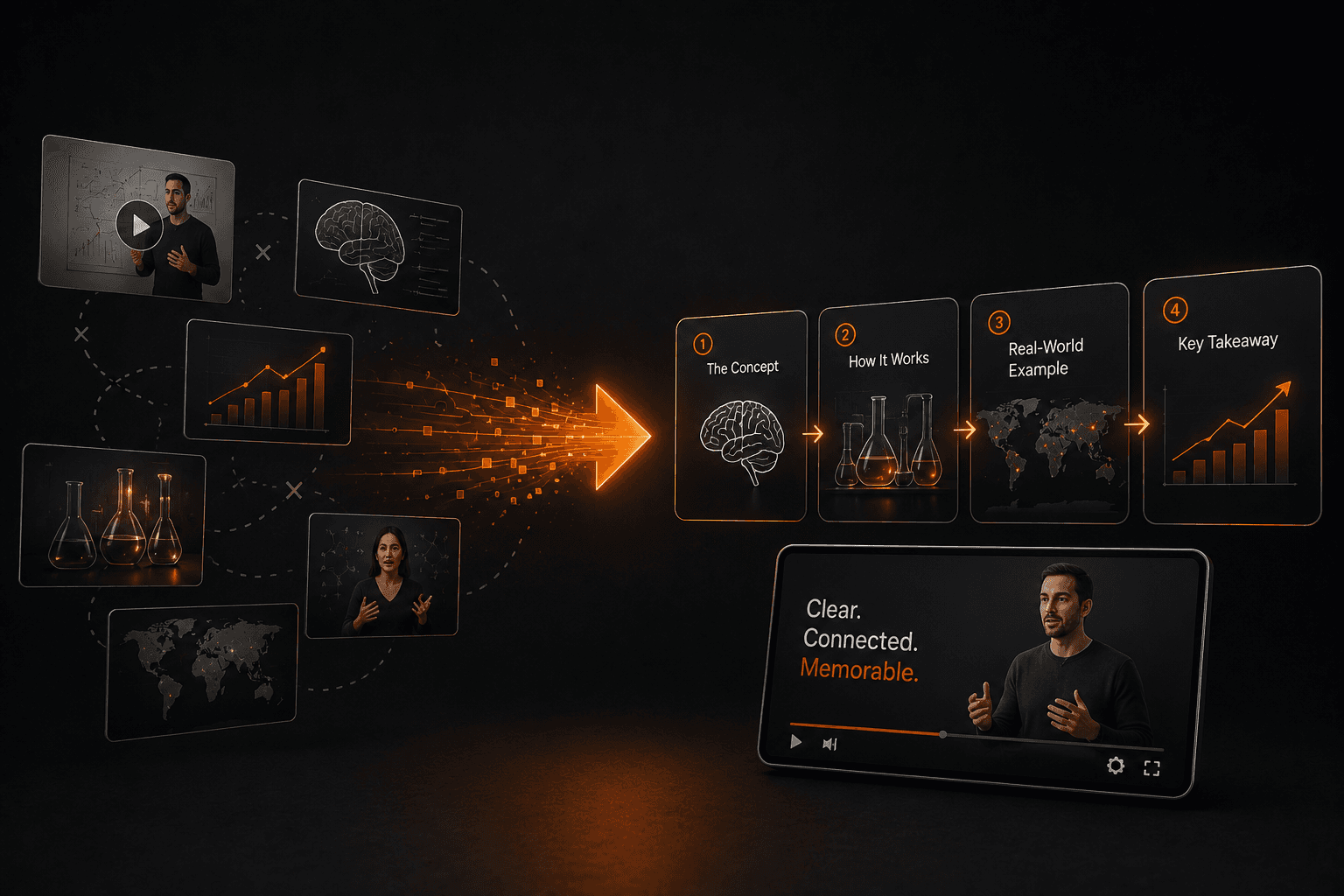
Facts are easier to use when learners understand how they fit together. Yet many educational videos present information as a list: definition, feature, rule, warning, summary. Each item may be correct, but the learner must create the connections.
Visual storytelling provides those connections. It gives the content a situation, a sequence, and a reason to move from one idea to the next.
This does not mean every lesson needs dramatic characters or a cinematic plot. In learning content, story is often a practical structure that helps learners answer: What is happening? Why does it matter? What should happen next?
Story Gives Information a Meaningful Sequence
A simple learning story usually contains four elements:
• Context: Where are we, and what is the learner trying to accomplish?
• Challenge: What problem, risk, or decision appears?
• Action: What does the person notice or do?
• Outcome: What changes as a result?
Imagine a lesson about identifying at-risk learners in an online course. A feature-led explanation might describe filters, reports, and notification settings. A story-led explanation follows a course manager who notices declining completion before an important deadline, uses a report to find the affected learners, and sends a targeted reminder.
The same features are taught, but each one appears at the moment it becomes useful.
Stories Provide Context for Decisions
Learners rarely apply knowledge as isolated facts. They apply it in situations filled with competing signals, incomplete information, and consequences.
A scenario can show:
• Which details deserve attention.
• What information is irrelevant.
• When a rule applies.
• What mistake a beginner might make.
• How one choice changes the outcome.
This is particularly useful in healthcare, compliance, customer onboarding, and technical training, where correct action depends on context.
Visual Continuity Reduces Mental Reconstruction
When every scene uses unrelated imagery, learners repeatedly have to determine where they are and how the new image connects to the last one.
Visual storytelling creates continuity. The same character, interface, object, or visual model carries the learner through the explanation. Changes on screen represent changes in the situation.
For example, a recurring dashboard can move from an overview to a highlighted alert, then into the relevant report, and finally to a completed action. The learner does not have to reconstruct the environment in every scene.
Cause and Effect Become Visible
Stories help learners connect action with consequence.
Instead of stating that delayed feedback reduces learner progress, show the sequence: a warning is missed, the learner continues struggling, the deadline approaches, and intervention becomes more difficult. Then contrast it with an earlier response.
The learner can see not only what the correct behavior is, but why it matters.
Contrast Makes the Lesson Memorable
One of the strongest learning structures is a comparison between two paths:
• A common mistake and its result.
• A better decision and its result.
• A novice approach and an expert approach.
• A confusing explanation and a clear one.
Contrast makes the boundary visible. It also gives the learner a retrieval cue: when they encounter a similar situation, they can recognize which path it resembles.
Keep the Story in Service of the Objective
Storytelling can become distracting when the setup, personalities, or decorative details receive more attention than the learning point.
Every story element should perform a teaching job. Ask:
• Does this detail help the learner understand the situation?
• Does this event create the decision we need to teach?
• Does the outcome demonstrate the consequence clearly?
• Could the story be shorter without losing the lesson?
The story should make the concept easier to follow, not become another concept the learner must decode.
Use Realistic Details Without Recreating Every Detail
Authenticity matters, especially for experienced audiences. A scenario that ignores real constraints can damage trust.
Work with SMEs to identify the few details that make the situation credible: the language people use, the order in which information appears, the pressure affecting the decision, or the most common mistake.
At the same time, avoid recreating every part of the environment. Selective realism keeps attention on the learning objective.
Build Reusable Story Patterns
For a growing video library, visual storytelling does not have to be reinvented for each lesson. A repeatable pattern can create consistency and speed.
Examples include:
• Situation, warning sign, decision, outcome.
• Goal, obstacle, tool, result.
• Incorrect approach, consequence, corrected approach.
• Before, intervention, after.
• Question, evidence, conclusion.
These structures can share characters, environments, interface components, transitions, and graphic rules while adapting to different topics.
Measure More Than Entertainment
A visually appealing story may hold attention, but the real test is whether it supports understanding and action.
After the lesson, can learners:
• Identify the important cue?
• Explain why the decision was correct?
• Predict the consequence of a different choice?
• Apply the same principle in a new example?
If not, the story may be memorable while the lesson remains unclear.
Story Is a Structure for Meaning
Visual storytelling helps learners organize knowledge around situations, decisions, and outcomes. It replaces a disconnected list of information with a path the learner can follow.
When used with discipline, story does not dilute complex content. It makes the relationships inside that content easier to understand, recall, and apply.
Facts are easier to use when learners understand how they fit together. Yet many educational videos present information as a list: definition, feature, rule, warning, summary. Each item may be correct, but the learner must create the connections.
Visual storytelling provides those connections. It gives the content a situation, a sequence, and a reason to move from one idea to the next.
This does not mean every lesson needs dramatic characters or a cinematic plot. In learning content, story is often a practical structure that helps learners answer: What is happening? Why does it matter? What should happen next?
Story Gives Information a Meaningful Sequence
A simple learning story usually contains four elements:
• Context: Where are we, and what is the learner trying to accomplish?
• Challenge: What problem, risk, or decision appears?
• Action: What does the person notice or do?
• Outcome: What changes as a result?
Imagine a lesson about identifying at-risk learners in an online course. A feature-led explanation might describe filters, reports, and notification settings. A story-led explanation follows a course manager who notices declining completion before an important deadline, uses a report to find the affected learners, and sends a targeted reminder.
The same features are taught, but each one appears at the moment it becomes useful.
Stories Provide Context for Decisions
Learners rarely apply knowledge as isolated facts. They apply it in situations filled with competing signals, incomplete information, and consequences.
A scenario can show:
• Which details deserve attention.
• What information is irrelevant.
• When a rule applies.
• What mistake a beginner might make.
• How one choice changes the outcome.
This is particularly useful in healthcare, compliance, customer onboarding, and technical training, where correct action depends on context.
Visual Continuity Reduces Mental Reconstruction
When every scene uses unrelated imagery, learners repeatedly have to determine where they are and how the new image connects to the last one.
Visual storytelling creates continuity. The same character, interface, object, or visual model carries the learner through the explanation. Changes on screen represent changes in the situation.
For example, a recurring dashboard can move from an overview to a highlighted alert, then into the relevant report, and finally to a completed action. The learner does not have to reconstruct the environment in every scene.
Cause and Effect Become Visible
Stories help learners connect action with consequence.
Instead of stating that delayed feedback reduces learner progress, show the sequence: a warning is missed, the learner continues struggling, the deadline approaches, and intervention becomes more difficult. Then contrast it with an earlier response.
The learner can see not only what the correct behavior is, but why it matters.
Contrast Makes the Lesson Memorable
One of the strongest learning structures is a comparison between two paths:
• A common mistake and its result.
• A better decision and its result.
• A novice approach and an expert approach.
• A confusing explanation and a clear one.
Contrast makes the boundary visible. It also gives the learner a retrieval cue: when they encounter a similar situation, they can recognize which path it resembles.
Keep the Story in Service of the Objective
Storytelling can become distracting when the setup, personalities, or decorative details receive more attention than the learning point.
Every story element should perform a teaching job. Ask:
• Does this detail help the learner understand the situation?
• Does this event create the decision we need to teach?
• Does the outcome demonstrate the consequence clearly?
• Could the story be shorter without losing the lesson?
The story should make the concept easier to follow, not become another concept the learner must decode.
Use Realistic Details Without Recreating Every Detail
Authenticity matters, especially for experienced audiences. A scenario that ignores real constraints can damage trust.
Work with SMEs to identify the few details that make the situation credible: the language people use, the order in which information appears, the pressure affecting the decision, or the most common mistake.
At the same time, avoid recreating every part of the environment. Selective realism keeps attention on the learning objective.
Build Reusable Story Patterns
For a growing video library, visual storytelling does not have to be reinvented for each lesson. A repeatable pattern can create consistency and speed.
Examples include:
• Situation, warning sign, decision, outcome.
• Goal, obstacle, tool, result.
• Incorrect approach, consequence, corrected approach.
• Before, intervention, after.
• Question, evidence, conclusion.
These structures can share characters, environments, interface components, transitions, and graphic rules while adapting to different topics.
Measure More Than Entertainment
A visually appealing story may hold attention, but the real test is whether it supports understanding and action.
After the lesson, can learners:
• Identify the important cue?
• Explain why the decision was correct?
• Predict the consequence of a different choice?
• Apply the same principle in a new example?
If not, the story may be memorable while the lesson remains unclear.
Story Is a Structure for Meaning
Visual storytelling helps learners organize knowledge around situations, decisions, and outcomes. It replaces a disconnected list of information with a path the learner can follow.
When used with discipline, story does not dilute complex content. It makes the relationships inside that content easier to understand, recall, and apply.
Latest Insights
Explore More Learning Insights
Practical ideas on educational video, visual storytelling, and scalable content systems for eLearning and EdTech teams.

How to Reduce SME Review Time Without Sacrificing Accuracy
The goal is not to involve SMEs less where accuracy matters. It is to use their limited time on the decisions that genuinely require their expertise.
How to Reduce SME Review Time Without Sacrificing Accuracy
The goal is not to involve SMEs less where accuracy matters. It is to use their limited time on the decisions that genuinely require their expertise.

How to Scale a Video Library Without Losing Consistency
Consistency at scale does not come from making every video identical. It comes from defining which decisions should remain stable and which should adapt to the learning objective.
How to Scale a Video Library Without Losing Consistency
Consistency at scale does not come from making every video identical. It comes from defining which decisions should remain stable and which should adapt to the learning objective.

The Hidden Cost of Rebriefing a New Video Freelancer for Every Project
The invoice for a video does not show the internal hours spent explaining the audience, content, visual standards, approval process, and earlier decisions all over again.
The Hidden Cost of Rebriefing a New Video Freelancer for Every Project
The invoice for a video does not show the internal hours spent explaining the audience, content, visual standards, approval process, and earlier decisions all over again.

Why Clear Course Previews Increase Learner Confidence
A strong course preview does not simply promote the curriculum. It lets prospective learners experience enough of the teaching to imagine themselves succeeding.
Why Clear Course Previews Increase Learner Confidence
A strong course preview does not simply promote the curriculum. It lets prospective learners experience enough of the teaching to imagine themselves succeeding.
Turn complex training content into a clear, consistent video library, without repeatedly briefing new production vendors.
Need a Reliable Video Partner for Your Learning Content?
Need a Reliable Video Partner
for Your Learning Content?
Turn complex training content into a clear, consistent video library, without repeatedly briefing new production vendors.
Need a Reliable Video Partner for Your Learning Content?
Turn complex training content into a clear, consistent video library, without repeatedly briefing new production vendors.